
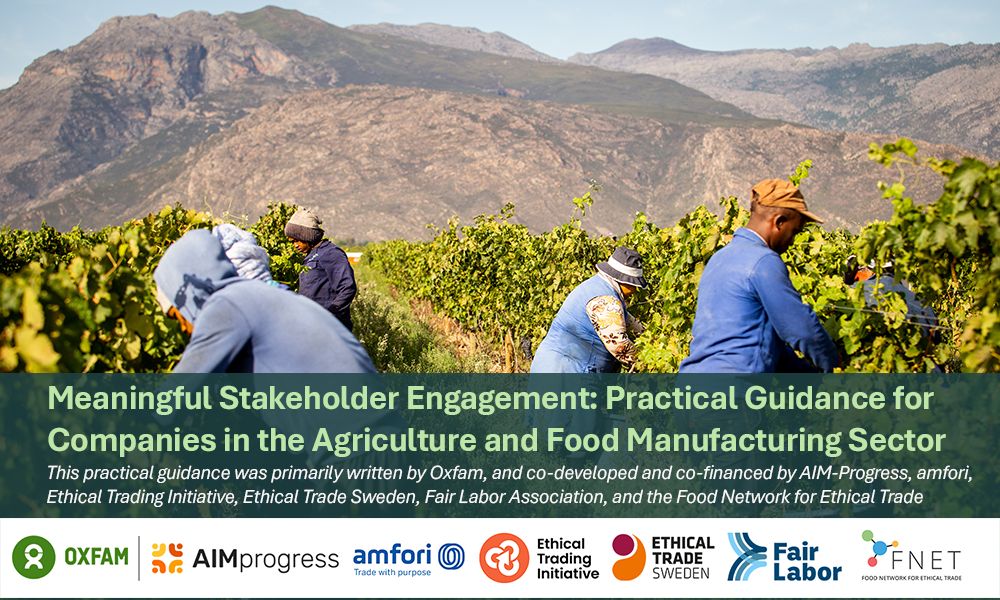
When Oxfam Netherlands approached me to edit their new Meaningful Stakeholder Engagement (MSE) guidance, the brief was straightforward in principle: take a substantial, carefully researched document and make sure it was consistent, accessible, and publication-ready. In practice, it was one of the more demanding editorial projects I’ve taken on – and one of the most rewarding.
The project
Launched in May 2026, the Meaningful Stakeholder Engagement: Practical guidance for companies in the agriculture and food manufacturing sector is a 119-page resource designed to help companies strengthen their engagement with workers, farmers, and communities as part of human rights and environmental due diligence (HREDD). It’s grounded in the UN Guiding Principles on Business and Human Rights and the OECD Guidelines, and it comes at a moment when that regulatory framework is getting tougher – with legislation like the EU Corporate Sustainability Due Diligence Directive (CSDDD) making real stakeholder engagement not just good practice but a legal expectation.
The guidance is practical in the fullest sense: structured around the questions of who to engage, how, and when, it offers step-by-step support, real company examples, a stakeholder mapping tool, and an impact tracking tool. It was produced collaboratively by Oxfam and six co-developing organisations – AIM-Progress, amfori, the Ethical Trading Initiative, Etisk Handel Sverige, the Fair Labor Association, and the Food Network for Ethical Trade – with input from companies, trade unions, civil society organisations, and rightsholders throughout.
That collaboration is what makes the guidance so authoritative – but it’s also what made the editing job so complex.
The editorial challenge
A document produced by multiple organisations across different sectors brings inevitable variation: in tone, in register, in how technical concepts are explained, in how much is assumed of the reader. My job was to make the final document read as one coherent piece of work – a clear, usable resource that practitioners in procurement, sustainability, and human rights roles could actually pick up and use.
That meant working closely with Oxfam’s detailed editorial style guide throughout, ensuring every section met the same standard for consistency and clarity. It also meant making judgement calls about language: this guidance needed to be accessible to a wide business audience without losing the nuance that makes it useful. Terms like ‘rightsholder’, ‘grievance mechanism’, or ‘heightened due diligence’ carry specific meaning in this field – simplifying them carelessly would have undermined the document’s integrity. The aim was always precision first, then accessibility.
The project ran over approximately a month, with iterative rounds of edits and feedback. Mira Alestig at Oxfam Netherlands was my single point of contact throughout, and her clear project management made a real difference to the quality of the process – and the outcome.
The importance of good editing
Human rights due diligence guidance only works if people can read it, understand it, and act on it. The best research and policy thinking in the world loses its impact if the document that contains it is inconsistent, inaccessible, or hard to navigate. Editing at this level is about making sure the intended audience can find what they need, trust what they’re reading, and feel equipped to do something with it.
You can access the full guidance and supporting tools here.
If you need support on an editing or writing project, however complex it may be, get in touch. I’d love to help.